Custom Solar Solutions That Power Your Projects Forward

Every project gets dedicated support, tailored solutions, and real-time updates.

overhead line power supply

Overhead Line Power Platform

A rugged clamp-on power platform combining CT energy harvesting and solar input—built to keep overhead line devices online across remote distribution network monitoring corridors.

Why Power is the First Failure Point in Overhead Line Monitoring

For many power line monitoring system deployments, the sensing hardware is not the bottleneck—power continuity is. Battery-only designs increase tower climbs and downtime risk, while building auxiliary LV feeders is costly and slow. A self-powered platform helps utilities maintain continuous remote monitoring and real-time alerting even in hard-to-reach spans.

Solar-powered_fault_location_device_ls-fd100

What this Product is

This is not a “charger.” It is a self-powered platform that mounts on the conductor and provides regulated DC power for your monitoring payload (fault indicators, small gateways, sensors, compact video, etc.). It becomes the power layer inside your overhead line monitoring architecture.

LINKSOLAR LS-7V4JK Overhead Line Power Platform

Key Capabilities

Dual energy input for higher uptime

  • CT energy harvesting from conductor current
  • Solar assist to stabilize charging during low-load periods
  • Internal battery charging management to bridge nights and low-current windows

Utility-grade enclosure & EMC resistance

Aluminum alloy housing supports harsh grid environments and improves long-term reliability for utility monitoring projects.

Fast clamp-on deployment

Clamp-on design for overhead installation reduces construction effort compared with running new power feeders.

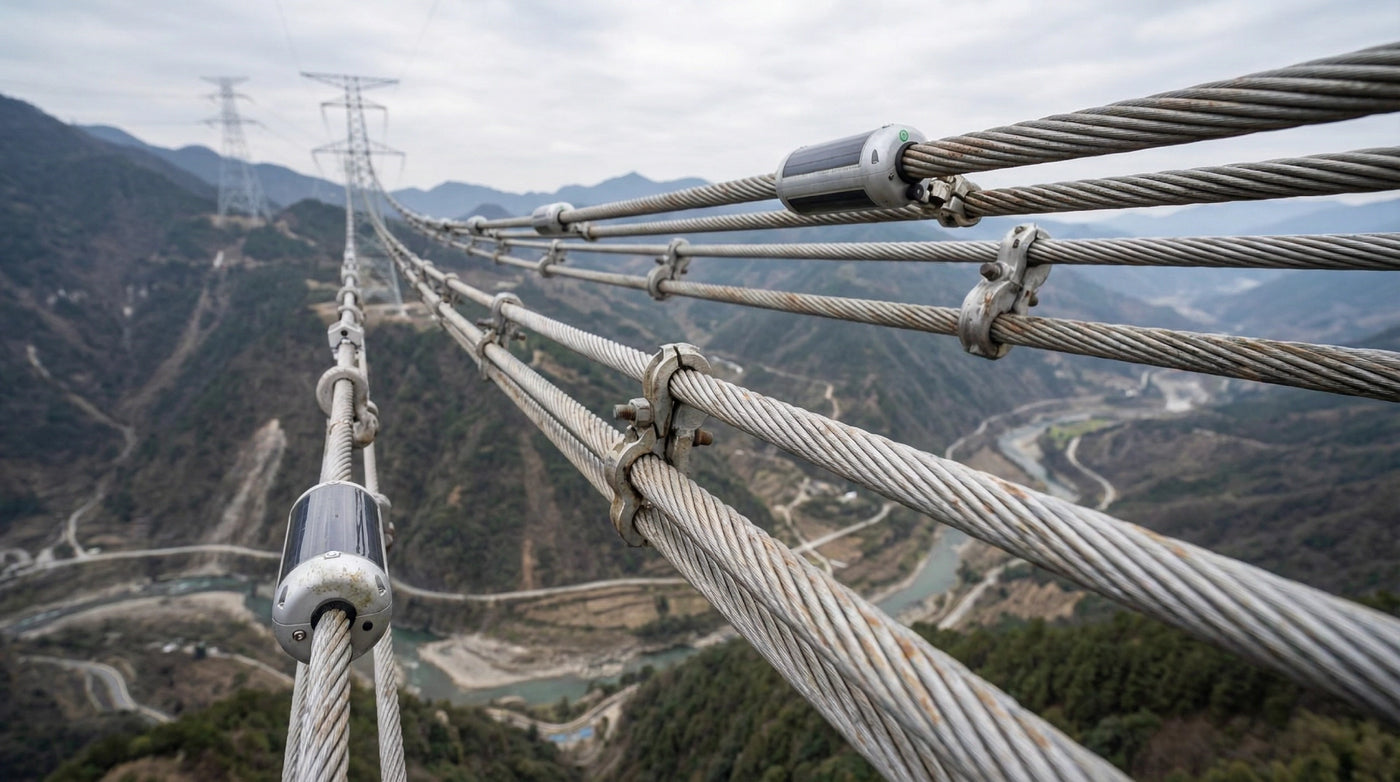
Looking down from the transmission tower, you can see multiple power lines and monitoring devices attached to the cables.

Where it Fits in a Distribution Network Monitoring System

Typical architecture

  1. JK power platform + monitoring payload (sensor / indicator / gateway) mounted on conductor
  2. Payload sends data via your selected communication (cellular/LPWAN/mesh)
  3. Data lands in your visual display platform / SCADA/DMS workflows

    This “system fit” explanation is common on high-performing utility product pages because it reduces integration uncertainty.
Overhead Line Power Platform LS-7V4JK

Best-fit Use Cases

  • Remote feeders and laterals where patrol time is expensive
  • Storm-prone corridors where device uptime is critical
  • Pilot-to-rollout programs that need standardized power + mounting platform

Models & Configurations

Model What’s Included Typical Fit
LS-7V4JK10000 Aluminum alloy enclosure + protective cover + PV panel Solar-assisted power platform for low/medium load payloads
LS-7V4JK10100 PV panel + CT energy harvesting Better uptime for overhead line monitoring in variable load corridors
LS-7V4JK10110 PV + CT + power pickup board For projects needing wider input/output flexibility
LS-7V4JK11110 PV + power pickup board + Li battery 7.4V 10Ah For extended autonomy needs in distribution network monitoring nodes

Key Specifications

Item Spec
Product Name Overhead Line Power Platform (Self-powered platform for monitoring payloads)
Model  LS-7V4JK Series
Application 35kV and above overhead transmission lines
Power Inputs CT energy harvesting + solar (dual input, configuration-dependent)
CT Output (typical) Output voltage 8.4V adjustable (±3%); current output 10A, output power >1.5W
Solar Panel (typical) Standard power 6.2W (±5%); nominal working voltage 12V (±10%); conversion efficiency 22%
Battery (typical option) Nominal voltage 7.4V; capacity 10Ah (model-dependent)
Power Pickup Board (option) External input 8V–75V; output 5V–24V
Connectivity Support 4G / GPS (BeiDou) / 2.4G (supported)
Mounting Clamp-on design; conductor diameter 23–40mm; clamping force lateral >50N
Ingress Protection IP66
Operating Temp -40°C to +85°C
Humidity 1%–100%
Material Aluminum alloy housing
Weight <5kg
Dimensions Length 335mm; major diameter 170mm; minor diameter 138mm
CT energy reference Primary current 5A >0.35W / 10A >1.50W / 20A >4.00W (test load 400Ω)
Battery pack space Battery pack can be customized (up to 8×18650 cells)

OEM / Custom Integration

  • Output voltage & regulated DC design matched to your payload
  • Connector & cable harness customization
  • Mechanical mounting adaptation for different conductor sizes
  • Branding / labeling for utility projects

    Pilot support:
    provide your payload power profile + reporting interval; we return a recommended configuration for your power line monitoring system node.

Frequently Asked Questions

Is JK just a power supply, or part of a power line monitoring system node?

JK is a self-powered overhead platform that becomes the power layer of your power line monitoring system node. It mounts on the conductor and provides stable DC power for your monitoring payload (fault indicators, sensors, small gateways, or other low-power devices), so your overhead line monitoring data stays online without adding new LV feeders.

What minimum line current is needed for CT energy harvesting to be useful?


CT harvesting output depends on conductor current. As a reference, the CT module has typical output power levels above 0.35W at 5A, 1.5W at 10A, and 4.0W at 20A (under the test condition). In real projects, we size the system by combining your device power profile + expected minimum current periods + solar conditions, then recommend the right configuration.

What output voltages can you provide for different monitoring devices?

Output is configurable by project. Typical architectures use regulated DC rails; with the optional power pickup board, the system supports a wider input range and provides 5V–24V output. If you share your device spec (voltage range + peak current), we can match the regulation, connectors, and harness.

How does the system behave during extended low-load periods or long nights?

The platform is designed for hybrid energy operation (CT + solar + battery option). Solar helps during low-current periods; battery bridges nights and short-term gaps. For distribution network monitoring deployments, we define an autonomy target (e.g., hours/days) and recommend the configuration (PV/CT/battery) that meets uptime requirements.

How is JK installed on overhead lines, and what conductor sizes does it support?

JK uses a clamp-on mounting structure designed for conductor diameter 23–40mm with clamping force lateral >50N. Installation workflows follow utility safety procedures and the project’s live-line/outage plan. We provide mounting guidance and harness drawings for integration with your monitoring payload.

Contact Us for a Quote & Technical Review

Tell us what you’re building and where it will be deployed. We’ll recommend a suitable configuration and provide a fast quotation.
Typical response: within 24–48 hours (business days).