Most campervan and van life setups use one of three things, or a mix: a flexible solar panel bonded to the roof, a folding panel you set out in the sun while the van parks in the shade, and a small trickle panel that keeps the starter battery topped up. This collection has all three, plus the roof cable-entry glands that finish a roof install.
How much solar does a camper van need?
Work from the energy you use per day, then size the panels to it.
-
Daily watt-hours: watts × hours of use for each device (fridge, lights, fan, laptop, phones), added up. One watt-hour is one watt used for one hour (EIA).
-
Peak sun hours: divide by the peak sun hours where you travel; a site's daily solar energy in kWh/m² equals its peak sun hours (NLR). Look up your route in PVWatts from NLR, and size for the lowest-sun month you plan to travel in.
-
Losses: PVWatts assumes 14% total system losses by default (NLR). A flat roof panel is not aimed at the sun, so treat that as a minimum.
Worked example: 800 Wh a day at 4 peak sun hours is 800 ÷ 4 = 200 W, and 200 ÷ 0.86 ≈ 233 W. Two 135 W flexible panels on the roof (270 W) cover it; one 135 W roof panel plus a 100 W folding panel for camp days is the other way to get there.
Roof: flexible solar panels for vans
A flexible solar panel with SunPower cells sits flat on a van roof, adds little height and needs no rack. The product page lists the 100 W panel at 1247 × 418 mm and about 1.0 kg, and the 135 W at 545 × 1180–1374 mm and 1.8–2.0 kg, with an anti-slip ETFE front, front or rear junction box, MC4 connectors and an operating range of −20 °C to +65 °C.
-
Measure the clear roof area between fan, vents and roof rails before you choose 100 W or 135 W; the panel needs to lie flat or on a gentle curve, not across a raised vent.
-
Bring the cable through the roof with a gland. The single cable entry gland and double cable entry gland come in 2–6 mm² and 6–12 mm² cable ranges. The double gland set lists one ABS box, two cable glands and two rubber seals; adhesive, sealant and screws are not included, so choose them for your roof material.
-
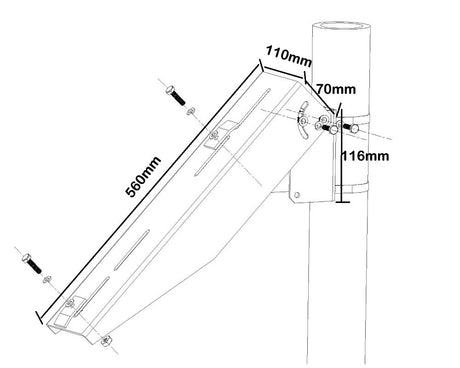
Framed (rigid) panels mount on brackets instead; Z-brackets and tilt mounts are in solar panel brackets.
More on fit, mounting and lifespan: flexible solar panels for RVs and boats, and a cell-level build in SunPower cells for RV and van solar.
Ground: folding panels for when the van is in the shade
Parking in the shade keeps the van cool but starves a roof panel. A folding panel on a lead lets you park in the shade and put the panel in the sun, and re-aim it as the sun moves. Figures below are from each product page.
-
100 W ETFE folding panel: 3.8 kg, folds to 58.42 × 53.34 cm, Voc 21.6 V, IP68-rated and silicone-sealed. MC4 cable with DC5521, Anderson, XT60 and DC7909 ends in the package.
-
100 W two-section folding panel: 3.2 kg, MC4 leads, DC barrel and Anderson adapter options (verify the cable configuration).
-
100 W six-section panel: 2.7 kg, DC up to 20 V / 5 A plus USB-C PD up to 45 W for a laptop straight from the panel.
-
120 W four-fold panel: 4.3 kg, folds to 47.2 × 45.4 cm, kickstands at 20°, 40° and 60°, IP65 panel surface.
-
150 W three-fold panel: 4.2 kg, 17.4 V / 8.62 A maximum output.
-
200 W six-section panel with pouch: 4.8 kg, folds to 460 × 415 × 75 mm, 20 V working voltage.
-
200 W fabric four-section panel: 4.2 kg, USB-A QC3.0, USB-C and DC5525 with MC4 cable options.
-
200 W TOPCon folding panel: 5.76 kg, opens to 200 × 62 cm, Voc 21.11 V, IP65 panel surface.
Fabric-backed folding panels that pack flattest are grouped as solar blankets.
Starter battery: a trickle panel for a parked van
A van that sits for weeks between trips can flatten its starter battery. The 12 W solar trickle charger mounts inside the windscreen on four suction cups or stands on its rear support, and connects with a battery clip lead. It is a supplemental charger for a 12 V battery, not a house-battery system; check the battery chemistry and connection before use, and if you use the power socket, confirm it stays live with the ignition off. For other 12 V batteries and a 10A MPPT controller, see 12V solar battery chargers.
Wiring it to the house battery or a power station
-
House battery: panels go through a solar charge controller (or the solar input of a DC-DC charger) to the battery, never straight to the battery terminals.
-
Power station: the panel's open-circuit voltage (Voc) has to sit inside the station's solar input range; a plug that fits is not proof the voltage is right. Panels with MC4 or DC outputs are grouped in solar panels for power stations.
-
Roof plus ground panel: check how your controller or power station accepts a second input before paralleling two panels with different voltages.
Frequently asked questions
Is flexible or rigid better for a van roof?
Flexible panels are lighter, lower and need no rack, which suits a van roof with curves or limited height; framed rigid panels on brackets leave an air gap under the panel and are easier to remove. Many van builds use flexible on the roof and a folding panel on the ground.
How many watts of solar do I need for van life?
Divide your daily watt-hours by the peak sun hours on your route, then by 0.86 for losses. 800 Wh a day at 4 peak sun hours works out to about 233 W.
How do I get the solar cable into the van?
Through a roof cable entry gland sized to the cable cross-section (2–6 mm² or 6–12 mm² on the glands here), sealed for your roof material.
Can I charge a laptop directly from a van solar panel?
Yes, with a panel that has USB-C PD output, such as the 100 W six-section panel (up to 45 W on USB-C PD), as long as your laptop accepts that profile. Output drops with cloud and shade.
Can you build a van solar panel to our size or brand?
Yes. Flexible panels built to your roof footprint, voltage, connector layout and branding are on custom flexible solar panels, and for folding panels on custom foldable solar panels. For larger RV roofs, see RV solar panels; for towed caravans and motorhomes, see caravan and motorhome solar panels.


 Esgotado