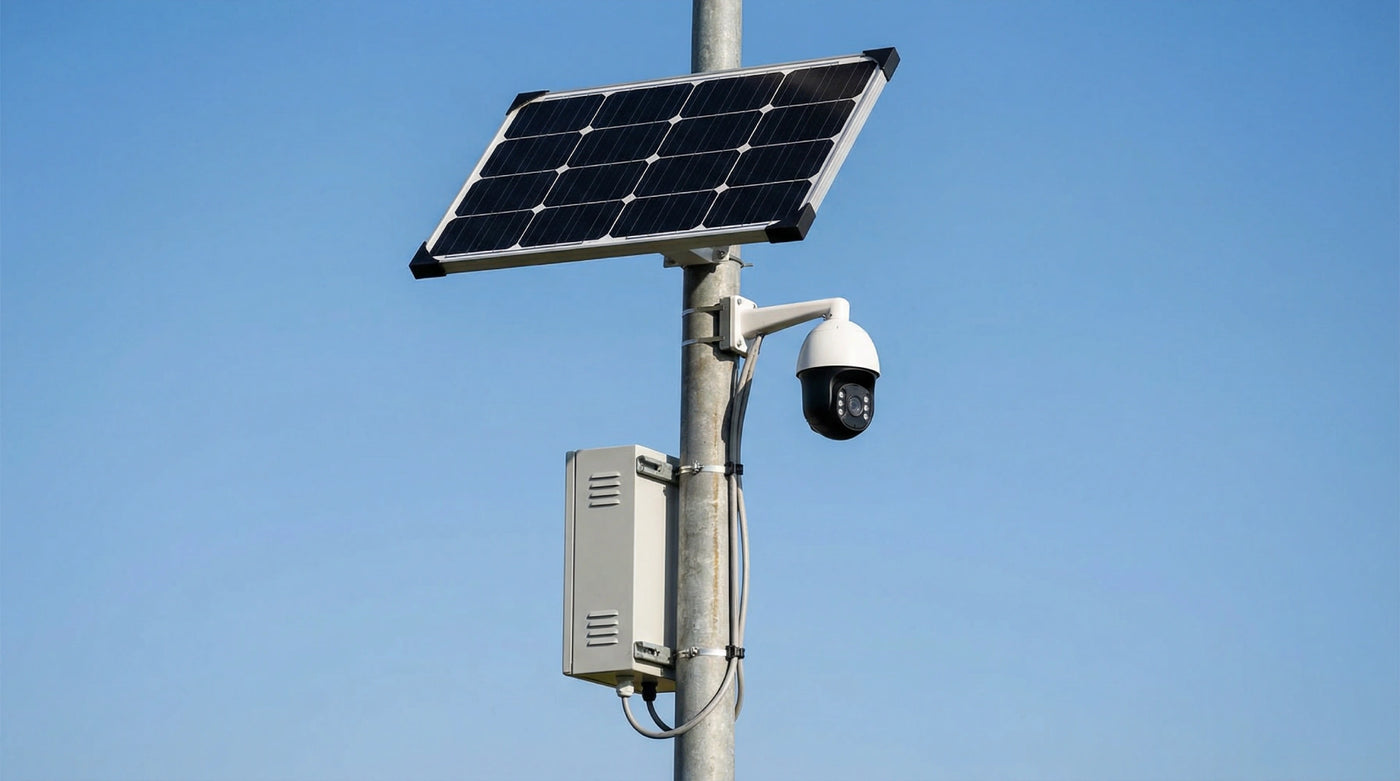
Short answer: a 4G security camera drawing about 6 W continuously needs roughly 240 Wh/day after losses — that is a 70 W panel in a 3.5 sun-hour month, and about 60 Ah at 12 V for three days of autonomy. Everything below is how to adjust that for your camera, your climate and your gate motor.
Keep eyes on the site and access moving—without trenching AC or babysitting batteries. LinkSolar designs compact, reliable solar for 4G/Wi-Fi/PoE cameras, NVRs, routers, and gate openers. The goal is simple: predictable daily harvest and clean wiring that’s safe to service.
Who This Is For
- Remote entrances, farms, yards, and construction sites where AC runs are impractical.
- Camera poles with partial canopy or shifting shade across the day.
- Gate motors that need standby power plus short, high-current pulses.
- Projects that want fewer truck-rolls through better autonomy and field-serviceable hardware.

Sizing That Won’t Lie
- Budget energy, not just watts. Add all device watts × hours = Wh/day. Include idle/standby for cameras, routers, IR LEDs, and gate controllers.
- Design for the worst month. Divide Wh/day by worst-month sun-hours to get panel watts.
- Add losses (20–30%). Controllers, wiring, temperature, and DC-DC conversion.
- Choose autonomy. 1–2 days for milder climates; 3–5+ days if security must stay up through storms.
- PoE realism. Injectors/switches add overhead; direct DC powering of cameras/routers is more efficient when possible.
Example (4G camera + router):
Camera 6 W (avg) × 24 h = 144 Wh; Router 2 W × 24 h = 48 Wh → 192 Wh/day.
Losses 25% → ~240 Wh/day. Worst month 3.5 sun-hours → ~70 W panel.
With 3 days autonomy → ~720 Wh battery (≈ 60 Ah @ 12 V usable).

Placement & Mounting That Beat Adding More Watts
- Panel placement beats panel size. Put the module above fence lines and arm gates to escape moving shade.
- Aim & tilt matter. 30–45° tilt improves winter harvest and sheds rain/snow; re-aim seasonally if you can.
- Short, tidy wiring. Keep DC runs short; use the right AWG for distance; add a drip loop at the entry gland.
- Service without ladders. Mount the enclosure at chest height; leave slack and labeling for fast swap-outs.

Power Architectures That Actually Work
- Direct DC camera systems (4G/Wi-Fi). Panel → Controller → 12 V battery → Camera/Router via DC feed. Prefer DC-DC buck to camera voltage; use a low-voltage disconnect (LVD) to avoid brownouts/corruption.
- PoE camera systems. If you must use PoE, budget the injector/switch overhead; keep the PoE run short; choose an MPPT when panel Vmp is well above battery voltage or when strings are used.
- Gate openers. Motor pulses demand stiff wiring and fusing; isolate the camera/router power from motor spikes using dedicated regulators or filters. Verify duty cycle of gate operations (opens/day) when sizing autonomy.
Build Your Security & Gate Solar Kit
-
![113×113 mm glass mini solar panel shown at an angle with rounded corners and 3×3 cell layout.]()
Mini Solar Panels (0.11–2.3 W)
— trickle for sensors & low-draw devices -
![Illustration of a small solar panel mounted to a wall using the bracket, front view.]()
5–10 W Wall/Pole Bracket
— compact mounting for small camera nodes -
![Close-up of tilt slot and fasteners on the pole mount bracket.]()
Solar Panel Pole Mount Kit (5–50 W)
— raise modules above moving shade -
![Four-pole DC circuit breaker with four levers and terminal knockouts, front angle view.]()
DC Breaker Selection Guide
— protect battery-side wiring; safer service -
![Crimping tool with MC4 male/female connector pairs and two plastic spanner keys.]()
MC4 Crimping Tool
— reliable field terminations & repairs


Work We’ve Delivered — Security & Gate
| Customer / Use Case | Solution (key components) | Panel & Construction | Outcome |
|---|---|---|---|
Farm Entrance Camera | Pole-top module at 35°; chest-height enclosure; labeled in-line fuse; seasonal re-aim. Tilt bracket (15°–60°) | Glass-laminated 30 W; stainless clamps | Stable day/night video; fewer false outages in winter |
Storage Yard Gate | Separate DC rails for gate motor vs. camera/router; surge path to ground; torque-marked fasteners. Solar Panel Bracket collection | Framed 40–60 W; air-gap for cooling | Gate cycles + camera uptime without nuisance resets |
Rural Driveway | Camera + LTE router; weekly check of voltage/harvest; labeled disconnect. | 20–40 W array; 30–45° tilt | Remote diagnostics cut site visits; steady stream quality |
Construction Site Corner | Temporary pole with compact array; conduit down the pole; drip loop; color-coded harness | Framed 20–30 W; quick-release clamps | Reliable day/night surveillance during on-off shifts |
Ranch Back Gate | Battery autonomy sized for 4 storm days; low-voltage disconnect to protect storage | Mixed panel; sealed enclosure | No brownouts; controller logs confirm recovery after storms |
Park Perimeter | Camera cluster powered DC-direct; IR only at night; injector removed to save overhead | Small array; buck converters | Lower idle draw; improved nighttime runtime |
* Harvest varies with season, shading, temperature, and duty cycle. For exact sizing, send device datasheets and duty profile.