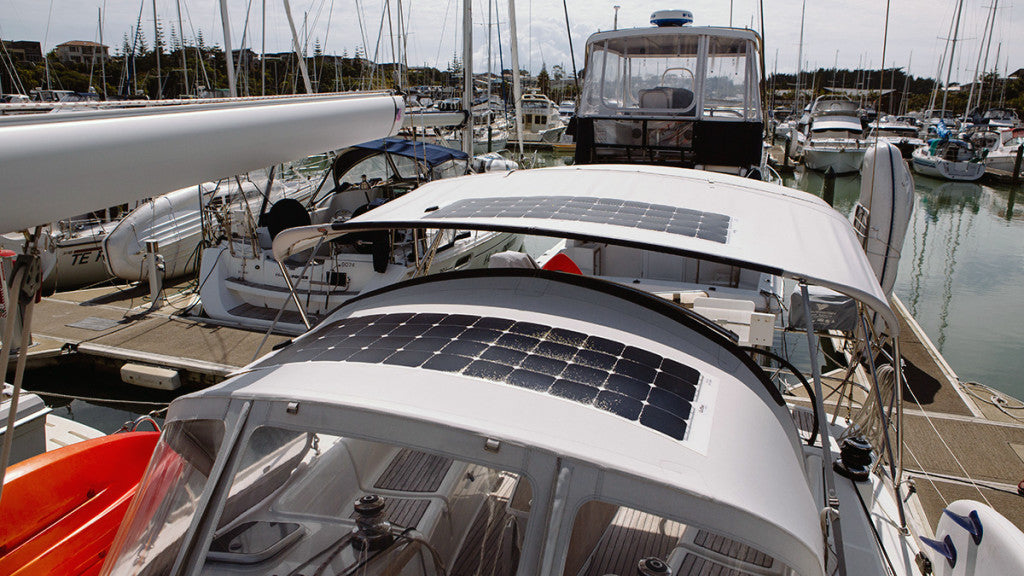


Flexible solar panels suit boats when the space is curved or too light to carry a frame. Fit starts from a measured outline, because panel sizes follow the cell grid and rarely fill a deck or bimini exactly.
LinkSolar is a China-based B2B supplier of custom & OEM solar panels, solar cells and mounting hardware.
How do you fit solar panels to a boat?
Start with the space and the battery, not with a wattage. Measure the deck, hardtop or bimini, and mark hatches, cleats, antennas and anything that shades the area. Cells come in fixed sizes, so the usable size moves in steps. A space wider than the largest panel allows may need two panels, and each panel needs its own junction box.
Wire by battery voltage. Panels in series or parallel should match what the charge controller accepts for your bank.
ETFE or PET on the water
ETFE is the usual top sheet for salt water and long service. PET costs less and suits shorter or lighter use. See the flexible panels, including ETFE models, on the flexible solar panel page.
Fixing the panel and routing the cable
Panels with a back sheet are usually bonded with solar-panel adhesive or double-sided foam tape, and sealing the edges helps stop them lifting. On fabric, use a mounting method made for the canvas; attaching flexible panels to a bimini covers the options.
Decide the junction box early. A rear box is better protected and hides the cable, but needs a cut-out or hole in the surface under it. A front box is easier to install, leaves the cable visible and uses part of the panel length. Never drill through the cell area, because that destroys the panel.
What to send for a boat panel
- Measured outline with keep-out areas, or a dimensioned drawing.
- Where the panel goes: deck, hardtop, bimini or cabin top, and whether it is curved.
- Battery voltage and charge controller.
- Junction box position and cable exit.
- Top sheet and how you plan to fix it.
Custom sizes are quoted on your drawing; see custom flexible solar panels.


