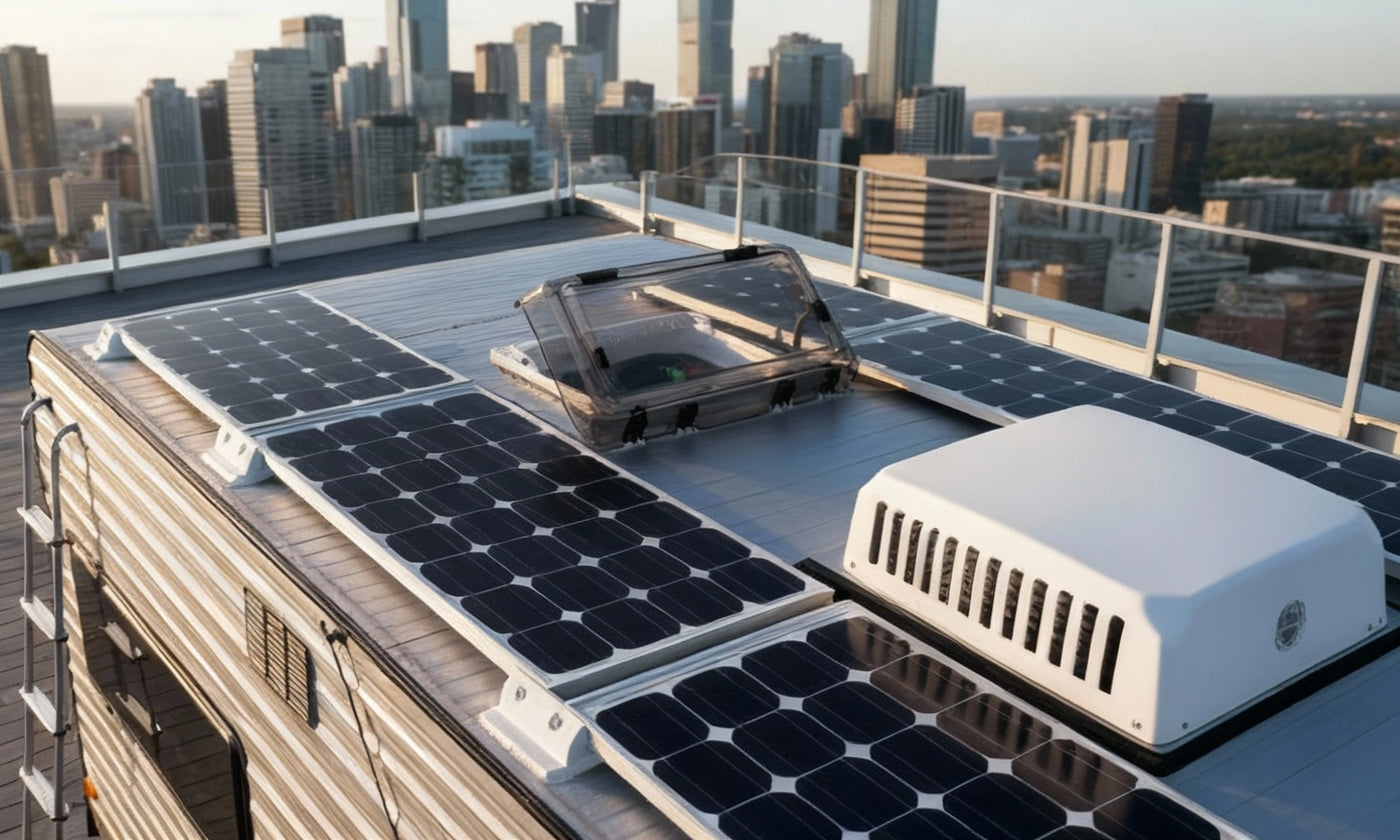
Most RVs need 100–200 W of solar for weekends, 200–400 W for full-time travel with a 12 V fridge, and 400 W or more for rigs with inverters and workstations. Stock for RV roofs: flexible panels, folding panels and Z-bracket kits.
How many solar panels do I need to run an RV?
Size the array from what you actually use in a day. Add up the watt-hours each device draws (watts × hours run), divide the total by the peak sun hours where you travel, then divide by 0.86 to allow for system losses — the sizing method we publish on our campervan solar panels and caravan and motorhome collection pages.
| How you travel | Typical array | What it runs |
|---|---|---|
| Weekend campers | 100–200 W (1–2 roof panels) | 12 V lights, fans, phone charging, small water pump |
| Full-time vanlife & Class B | 200–400 W | 12 V compressor fridge, vent fans, laptops and cameras |
| Power-hungry work rigs | 400–800 W | Inverter for tools or editing setups, multiple laptops and monitors |
Worked example: 800 Wh a day at 4 peak sun hours is 800 ÷ 4 = 200 W, and 200 ÷ 0.86 ≈ 233 W of panel — two 135 W roof panels cover it with margin.
RV solar parts in stock: size, output and price
| Part | Rating | Size and output | Price, USD |
|---|---|---|---|
| Flexible solar panel with SunPower cells | 50 W, 100 W, 135 W | 100 W: 1247 × 418 mm, 1.0 kg; 135 W: 545 × 1180–1374 mm, 1.8–2.0 kg; MC4 leads | 50 W 150.00 · 100 W 300.00 · 135 W 405.00 |
| RV solar panel Z bracket kit | 4 / 8 / 16 pieces | Rigid panels on Z-brackets, one- to four-panel layouts | 4 pcs 21.73 · 8 pcs 37.85 · 16 pcs 66.34 |
| Tilt mount bracket for RV roofs | Set | Seasonal tilt for rigid panels | 66.38 |
| 10A 12V MPPT charge controller | 10 A | USB-A and USB-C ports; check its PV input limit before pairing | 35.47 |
| 100 W ETFE foldable panel | 100 W | Set out at camp; MC4 adapter cable | 144.29 |
Prices read from Shopify on 2026-11-03; each product page shows the current price and options. Sizes are from the flexible-panel page and the listings.
Three ways to build the array
- Flexible panels bonded to the roof — follow curved fiberglass or metal roofs, keep height and weight low, and can be bonded directly to suitable surfaces. Stock sizes are 50 W, 100 W and 135 W in flexible solar panels; for panels built to your roof footprint, voltage and branding, see custom flexible solar panels.
- Rigid panels on Z brackets — run cooler with airflow underneath, suit flat sections or racks, and can be tilted seasonally. The RV solar panel Z bracket kit comes in 4, 8 and 16-piece sets for one- to four-panel layouts.
- Folding panels set out at camp — a portable panel moved into the sun when the van itself is parked in the shade: portable solar panels.
Buyer questions
Can you run an RV completely on solar power?
For 12 V loads, yes, if the array and battery are sized from your daily watt-hours: weekend rigs run on 100–200 W, full-time rigs with a 12 V compressor fridge on 200–400 W, and rigs with inverters, tools or workstations on 400–800 W. High-draw loads such as an air conditioner are sized separately from their running watts and hours; add them to your daily watt-hours before choosing panels. Start from the worked example above.
What are the best solar panels for a van roof?
On a curved or narrow roof, a low-profile flexible panel is the usual pick: the stock 100 W is 1247 × 418 mm and 1.0 kg, and the 135 W is 545 mm wide and 1.8–2.0 kg. Measure the free roof area in millimetres first, since the outline usually decides before the wattage does, and leave an air gap where you can. The flexible panels for RVs and boats guide covers bonding and heat; the campervan solar panels collection lists van picks.
Do you sell RV solar panel kits?
Stock listings are separate parts: flexible panels, Z-bracket kits in 4, 8 and 16-piece sets, and a 10A 12V MPPT charge controller. Add up your daily watt-hours, pick the panels, then send the roof dimensions and the parts you need and we quote from them.
LinkSolar is a China-based B2B supplier of custom & OEM solar panels, solar cells and mounting hardware.
SunPower is a trademark of its owner; mentioned only to identify the cell type.


