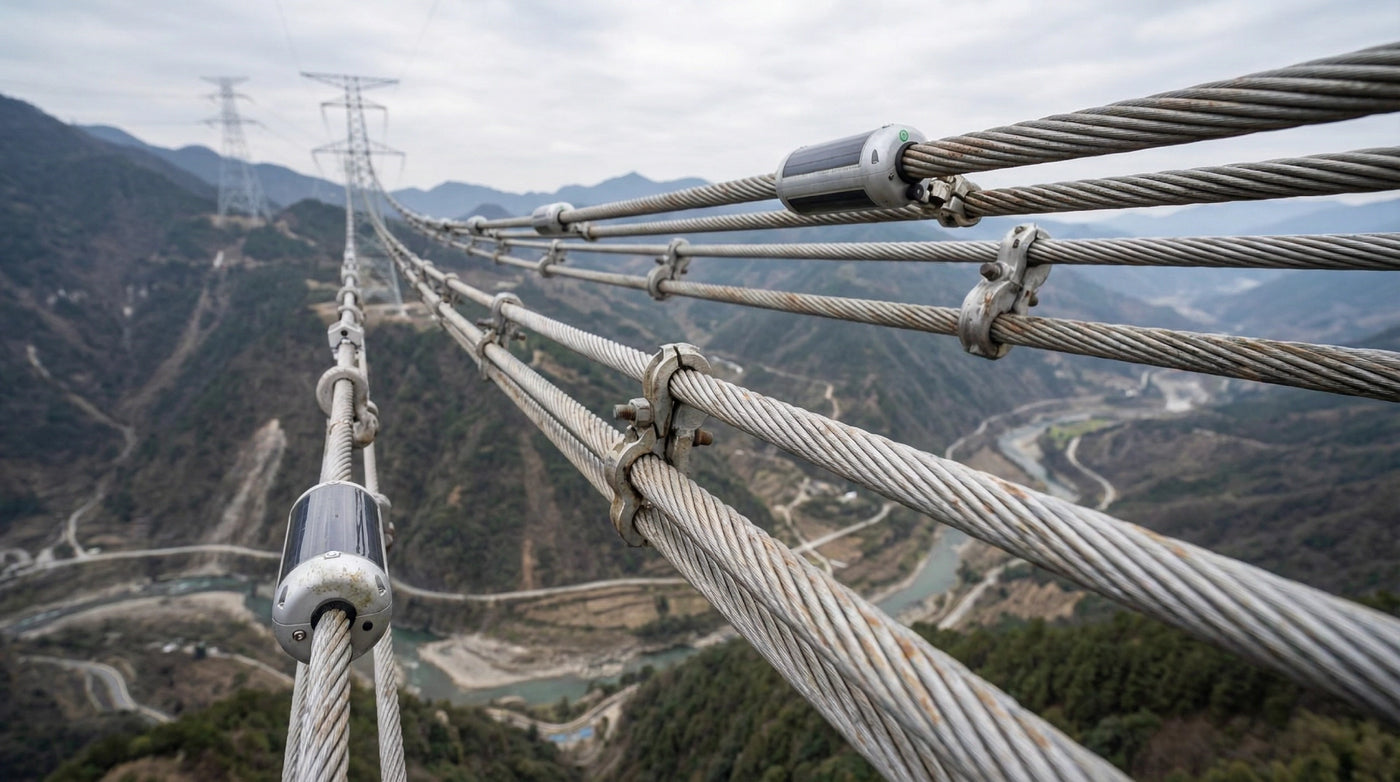

Varför ström är den svaga länken i nätövervakning
Smarta verktyg investerar i sensorer och analys, men i avlägsna områden är det ofta strömavbrott som är det första felet. Batteridrivna lösningar kräver återkommande klättringar i torn. Att lägga till en extra lågspänningsledning är långsamt och dyrt. När stormar slår till är den enhet som borde skicka en realtidsvarning ofta den första som går offline.
Det är därför moderna lösningar för övervakning av verktyg och nät alltmer behandlar ström som en kärnkomponent i systemarkitekturen – inte som en eftertanke.
Vad ett kraftledningsövervakningssystem vanligtvis inkluderar
När kunder söker efter övervakningssystem för kraftledningar menar de vanligtvis en komplett lösning:
Edge-enheter på linjen
Överspänningssensorer för felupptäckt, vågformsinspelning, belastningsövervakning och ibland övervakning av ledartemperatur.
Kommunikation och backhaul
Mobil-/mesh-/LPWAN-länkar från linjeenheter till en huvudstation eller molnplattform.
Visuell visningsplattform och analys
En plattform som omvandlar händelser till åtgärdsbara larm och arbetsflöden (felsökning, riskvarning, underhållsplanering).
Var LinkSolar passar in: vi tillhandahåller strömförsörjningslagret som håller dessa edge-enheter aktiva på luftledningar—så att din övervakning av luftledningar och nätverksövervakning för distribution förblir kontinuerlig.
LinkSolar kraftförsörjningssystem för luftledningar
LinkSolar’s system monteras direkt på ledaren och kombinerar:
- Strömupptagning från ledaren (energiinsamling) via en inbyggd strömtransformator
- Kurvat solcellsmodule för extra energi under perioder med låg ström eller låg belastning
- Intern Li-ion-batteri + reglerad likspänning för att leverera stabil lågspänning dag och natt
Energiinsamling för autonoma luftledningsenheter är en beprövad metod inom industri och forskning, just eftersom det minskar beroendet av batteribyten och bristande infrastruktur.
Rekommenderade enheter (35 kV+)
| Produkt/Modell | Typisk användning i systemet | Effektmetod | Batteri | Kommunikationer | Tangentövervakning / Funktioner | Storlek / Vikt |
|---|---|---|---|---|---|---|
JK Overhead Line Power Platform (LS-7V4JK-serien) | Självförsörjande plattform för att hålla linjeenheter online (felsökning / isbildning / galloperande noder, gateways, etc.) | CT energiskördning + solenergi (dubbel ingång); valfri strömupptagningskort | Konfigurationsberoende | Stöder 4G, GPS/BeiDou, 2,4G | Reglerad likspänningsutgång för nedströms last; klämfäste för ledare Ø23–40mm | 335 mm längd; <5 kg |
WD Övervakningsenhet för linjegallop (LS-3V7WD11010) | Övervakning av ledargalopp + relaterade tillståndssignaler (för övervakning av kraftledningar) | Solcellsdriven (inbyggt uppladdningsbart batteri) | 3,7V 6Ah (upp till ~30 dagars standby vid 5-minutersrapportering utan laddning) | LoRa-baserad lågströms trådlös; max TX 22dBm, upp till 500m i öppet område; kan kopplas till RS485 via mottagarmodul | Galloperande amplitud och frekvens, ledartemperatur, omgivningstemperatur/fuktighet; konfigurerbara tröskelvärden och varningar | Ø98 mm × 200 mm; ≤2 kg |
GB Isövervakning ”Ice Sprite” (LS-9V6GB11110) | Isövervakningssystem + videosäkerhet för linjekorridor; fjärrlarm till plattform | AC-induktion (nätenergi) + solenergi + högtemperaturslitiumbatteri | 9,6 V 14 Ah | Inbyggd 4G-modul; stödjer trådlös backhaul (4G/5G/WiFi) | AI-baserad analys av isbildningens tjocklek (visuell), uppladdning av bild/video i realtid; mäter ledarens temperatur och ström; linsens antifrostvärme | Kompakt cylindrisk hölje; lagring ≥128G |
* JK-strömförsörjningsplattformen erbjuder olika konfigurationsalternativ (såsom: endast solenergi, solenergi + CT, solenergi + CT + strömfördelningskort, solenergi + strömfördelningskort + batteri, etc.)
Användningsfall som stöds
Övervakning av luftledningar på distributionsmatningar
Strömförsörjning för felindikatorer, kompakta felinspelare och matarsensorer—så att operatörer kan återställa tjänsten snabbare och minska patrulleringstiden över distributionsnätets övervakningsområde.
Övervakning av transmissionsledningar vid svåra väderförhållanden
Stöd för isbildningsövervakningsenheter och ledartemperaturnoder som används för tillståndsmedvetenhet och riskvarningar. Många isbildningssensorer är särskilt utformade för sol-/batteriförsörjning vid tornplatser, vilket motsvarar verkliga begränsningar.
Videoövervakning av ledningskorridorer och bevakning av skogsbränder
Stabil likström för kompakta kameror och edge-enheter där kabelgrävning för ström är orealistiskt—vilket håller videoströmmen och larm online när väderriskerna är som störst.


Installation och fältarbete
Klämfast aluminiumhus
Lättviktsgjutet aluminiumhus med gångjärnsförsett topp/botten och integrerat klämfäste. Utformat för ledare med 23–40 mm i diameter, med greppstyrka över 50 N i tvärgående riktning.
Elliptisk profil med integrerat solskydd
Den strömlinjeformade ovala formen ökar solinfångningen på den böjda PV-ytan jämfört med platta kapslingar. PV skyddas av en glasplatta med hög genomsläpplighet, hög hållfasthet och gulningsskydd.
Design för tuffa miljöer
Fullt tätad enligt IP66 med driftstemperatur från –40 till +85 °C och fuktighet upp till 100 % RF. Lämplig för alpina, kustnära, öken- och tropiska miljöer, upp till 5500 m höjd.

Elektriska egenskaper
Linjespänning: 35 kV och uppåt luftledningar för överföring
CT-ingång: utformad för primärströmmar runt 5–20 A; typisk tillgänglig effekt ≥1,5 W till efterföljande kretsar
PV-ingång: cirka 6 W nominell med ~22 % moduleffektivitet
Batteri: 7,4 V / 10 Ah Li-ion-pack för flera dagars autonomi
DC-utgång: justerbar runt 8,4 V för att matcha din enhets ingång, med överspännings- och strömbegränsningsskydd
Viktiga fördelar för energibolag och systemintegratörer

Anpassad och systemintegration med LinkSolar
LinkSolar kan leverera kraftplattformen för luftledningar som en fristående produkt eller som en del av en komplett övervakningslösning.
- Utspänning, kontakter och kabelhärvor kan anpassas efter din sensor- och kommunikationsutrustning.
- Vi designar matchande små solmoduler och fästen när tornmonterade enheter också behöver hjälpkraft.
- Vårt tekniska team stödjer effektbudgetering, platslayout och pilotprojektplanering för överföringsföretag och lösningsleverantörer.
Vanliga frågor
Är detta bara en strömförsörjning, eller en komplett nod för övervakning av luftledningar?
Är detta bara en strömförsörjning, eller en komplett nod för övervakning av luftledningar?
Det är en självförsörjande övervakningsnod för överliggande ledningsövervakning – inte bara en strömmodul. Enheten integrerar energiskördning från ledaren (CT), en böjd solpanel, intern batterihantering och reglerade likströmsutgångar för att stödja övervakningslast. Beroende på ditt projekt kan vi leverera den som:
- Ström + kapslingsplattform för din valda sensor-/kommunikationsmodul, eller
- En mer integrerad front-end-nod anpassad till din distributionsnätsövervakningsarkitektur (ström + kabelsats + montering + gränssnittskrav).
Hur fortsätter den att övervaka online under perioder med låg belastning och långa nätter?
Hur fortsätter den att övervaka online under perioder med låg belastning och långa nätter?
Systemet använder en hybrid energistrategi: ledarenergiinsamling + solassistans + internt batteri. När linjeströmmen sjunker eller solljuset är begränsat, överbryggar batteriet gapet så att din övervakningslast förblir online. För övervakningsinstallationer för elnätet anpassar vi konfigurationen baserat på din lasts genomsnittliga/toppeffekt och nödvändiga autonomitimmar, så att noden förblir pålitlig över säsongs- och belastningsvariationer.
Hur väljer vi rätt utgångsspänning och kontakter för vår övervakningsutrustning?
Hur väljer vi rätt utgångsspänning och kontakter för vår övervakningsutrustning?
De flesta övervakningssystem använder reglerad likström, men den exakta spänningen och kontakttyperna varierar mellan olika enhetstillverkare. LinkSolar stödjer anpassade utgångsspänningar och kabelstammar för att matcha din övervakningsutrustning, inklusive val av kontakt, polaritetsskydd och dragavlastning för utomhusinstallationer. Om du tillhandahåller din enhets specifikationsblad (spänningsområde, toppström, kontakttyp) kan vi föreslå en färdig att integrera konfiguration.
Är installationen komplicerad? Behöver vi dra extra kablar eller lägga till ett separat elskåp?
Är installationen komplicerad? Behöver vi dra extra kablar eller lägga till ett separat elskåp?
Ingen extra lågspänningsmatning krävs. Enheten är byggd för montering ovanför och fästs nära platsen för övervakningsutrustningen. Detta minskar behovet av schaktning, skåp vid stolpar och återkommande batteribyten i höjd. Ditt team behöver vanligtvis bara följa standardprocedurer för linjetillgång, och vi tillhandahåller monteringsanvisningar samt grundläggande kopplingsscheman för integration av övervakningsutrustningen.
Hur validerar vi tillförlitlighet innan full utrullning (pilotstöd)?
Hur validerar vi tillförlitlighet innan full utrullning (pilotstöd)?
Vi rekommenderar en liten pilotstudie på representativa matningsledningar/sträckor. Vi hjälper dig att definiera: platsval, förväntade belastnings-/strömområden, ljusförhållanden, enhetens effektbudget samt larm- och drifttidsmål. Under piloten kan du verifiera kontinuerlig fjärrövervakning, batteriprestanda under värsta tänkbara perioder och stabiliteten i realtidsrapportering av larm. När detta är bekräftat standardiserar vi konfigurationen för storskalig implementering.
Kontakta Link Solar
Frågor om en produkt, beställning, specialpanel eller bulkoffert? Skicka ett meddelande så återkommer vårt team inom 1 arbetsdag.