
SunPower Flexible Solar Cells: What “Flexible” Really Means
If you’ve been searching SunPower flexible solar cells, you’ve probably noticed the same phrase used for three very different products: finished flexible modules, semi-flexible laminates, and standard SunPower-style cells that are simply used inside a flexible product. That confusion is normal—and it’s one of the fastest ways to buy the wrong thing overseas.
This guide explains the difference between a flexible solar panel SunPower cell listing and a flexible SunPower solar cell listing, what ETFE lamination usually implies, and the questions that turn messy quotes into apples-to-apples comparisons.
Flexible solar panel SunPower cell vs flexible SunPower solar cell
Most products marketed as “flexible” are finished laminates or flexible modules. You’ll see titles like “flexible solar panel SunPower cell” because the seller is highlighting the cell brand/type used inside the module. In these cases you’re buying a finished product, not loose cells—so your priorities shift to durability, waterproofing, connectors, and how the laminate is built. If you’re comparing finished options, start with a clear reference point like LinkSolar flexible solar panels.
When listings say “flexible SunPower solar cell” or “SunPower solar cell flexible,” the word flexible is often doing marketing work. Crystalline silicon wafers are still brittle. What bends is the laminate stack and the surface you mount it on—within a limited bend radius. If you actually need loose cells for a custom build, say that upfront, otherwise sellers will keep quoting flexible panels. For bare or cut cells, use a dedicated sourcing path like solar cells for custom panels.

What “flexible” really means in the real world
Think of “flexible” as contour-mountable, not rollable. A quality flexible laminate is designed to follow gentle curves on a stable surface (RV roofs, biminis, curved metal skins), not to be folded sharply or flexed like a cable. Over-bending can create micro-cracks in the cells that don’t show up on day one, but quietly reduce output later.
If your project involves curved mounting—or you’re not sure what your curvature translates to—use a supplier who will define bend radius and mounting zones with you. This is exactly what a proper custom program should cover: custom flexible solar panels for curved surfaces.
One quick reality check: if the application requires repeated flexing (for example, parts that move, flap, or get stepped on), a crystalline-silicon “flexible” laminate is usually the wrong product form. In those cases, truly flexible thin-film options may be a better fit. For example, flexible thin-film products like amorphous silicon flexible panels can tolerate different handling assumptions than wafer-based laminates.
What ETFE lamination usually signals
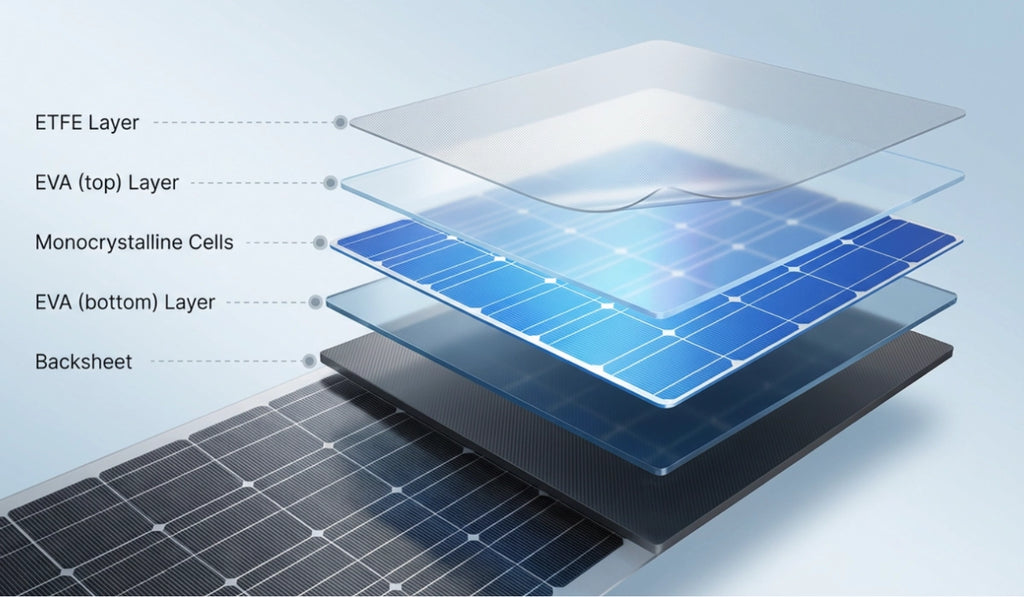
You’ll see phrases like “ETFE lamination” paired with SunPower cells in flexible product titles. ETFE is a fluorine-based plastic film used as a top layer in many flexible products. In procurement terms, ETFE is not automatically “good” or “bad.” It’s a design choice that affects abrasion resistance, weight, and long-term exposure behavior.
Instead of accepting “ETFE” as a quality stamp, ask the questions that actually control performance in the field: What is the top-layer thickness? What environment claims are being made (UV, salt mist), and what are they based on? Is the laminate intended for one-time contour mounting, or does it claim to survive repeated bending? Finally, request the operating temperature range and the supplier’s recommended minimum bend radius.
And don’t skip electrical reality. Many “flexible” listings headline wattage, but you still need a usable spec. Request Vmp, Imp, Voc, Isc at STC, then confirm the operating window matches your system.
C60 language inside flexible products: why it matters
Some flexible listings reference a cell family like “C60.” Buyers may search “SunPower solar cell flexible C60 mono cells specs” expecting a discrete cell datasheet. In many cases, the seller is describing the cell type used inside the laminate, not offering cells by themselves.
A simple rule keeps you out of trouble: If you are buying the laminate/module, request the laminate datasheet. If you are buying the cells, request the cell datasheet plus the delivery format (trays, interconnect options, handling notes). If you need both, say so explicitly so the quote includes the correct line items.
Real-world “flexible” searches: what buyers usually mean
Most inbound searches fall into a few intent buckets. Phrases like “sunpower flexible solar panel” usually mean a finished module. Phrases like “sunpower solar cell flexible” often mean the buyer wants the brand-type cell but hasn’t decided the product form yet. Longer strings that combine “Maxeon / C60 / 5x5 / 3.55W” often signal a kit or prototype buyer who needs a specific footprint, but is being pulled toward finished laminates by marketplace wording.
The safest way forward is to decide the product form first—finished panel, semi-flex laminate, or loose cells—then request the matching datasheet. If your goal is a ready-to-mount product for RVs, boats, or portable setups, compare against a finished product built on the same cells — our flexible panels (50 W / 100 W / 135 W).
What to verify before you order a flexible product overseas
If you’re buying a flexible laminate or flexible module, focus on the items that prevent “it arrived fine, but didn’t last” problems. Start with mechanical limits: get the minimum bend radius in writing, and confirm whether it’s for one-time mounting or repeated flexing. Then talk mounting: ask if adhesive mounting is allowed, what surface prep is required, and whether the laminate must be fully supported underneath.
Next, lock down electrical behavior with STC values (Vmp/Imp/Voc/Isc) and confirm compatibility with your controller and battery system. After that, get specific about connectors—connector type, cable length, and strain relief—because many failures happen where the cable exits the laminate. Finally, ask about protection design (bypass diodes, sealing method, partial-shading behavior) and request the datasheet plus any certificates required for your market.
If you want help turning your use case into a clean RFQ—finished flexible panel vs loose cells, target voltage/current, mounting constraints, and environment— share those details here and we’ll help you spec it properly: Contact LinkSolar.
Conclusion
“SunPower flexible solar cells” searches often mix product forms. Most “flexible” products are laminates or flexible modules that use silicon cells inside a flexible stack. Your sourcing success depends on identifying the product form and requesting the correct datasheet—then verifying bend radius, mounting assumptions, connectors, and STC electrical specs.
Note: “SunPower” and “Maxeon” may be trademarks of their respective owners. This article provides sourcing and verification guidance.