Leave Hookups Behind, Not Your Comfort
On the road, every system depends on your batteries:
fridge, vent fans, water pump, lights, chargers, even your workstation if you work remote.
Idling the engine wastes fuel and puts hours on the motor. Generators add noise, fumes, and maintenance. A properly sized RV solar array quietly refills your batteries whenever the sun is out, so you can:
- stay longer at remote boondocking spots,
- keep food cold and air moving on hot days,
- arrive at the next campsite with full batteries instead of empty ones.
LinkSolar’s RV solar solutions are built for people who actually live with their vehicles—weekend campers, full-time vanlifers, and RV manufacturers.
Typical RV Solar Setups & Power Ranges
-
![flexible solar panels installed on van roof for mobile off grid charging]()
Weekend Campers (100–200 W)
Small travel trailers and campervans that go out for a few days at a time usually run:
- 1–2 flexible panels on the roof (100–200 W total)
- 12 V lights, fans, phone charging, small water pump
Solar mainly replaces what you use overnight and keeps batteries healthy between trips. -
![rigid solar panels mounted on RV roof in desert canyon setting]()
Full-Time Vanlife & Class B Builds (200–400 W)
Full-timers and digital nomads add more continuous loads:
- 12 V compressor fridge
- vent fans running many hours
- laptops, cameras, routers, modems
Here we often see 200–400 W of solar on the roof, sometimes with a small portable panel that can be moved into the sun when the van itself is parked in the shade. -
![large RV rooftop solar panel system in forest campsite]()
Power-Hungry Work Rigs (400 W+)
Photo/video vans, mobile offices, and service vans may need:
- larger inverter for tools or editing setups
- multiple laptops / monitors
- high-draw DC equipment
For these users, we design higher-power arrays (400–800 W range) combined with appropriate charge controllers, fusing and wiring to keep the system safe and stable.


Stealth Vanlife Couple
A couple traveling full-time wants a quiet, “no-hookups” setup that fits between roof ribs and around the fan.
- 2–3 flexible ETFE panels bonded to the curved roof
- low-profile cable routing and junction boxes
- pre-labeled fuses and disconnects near the battery
Result: the fridge, lights, fan, and devices run day after day with minimal generator use and almost no wind noise.

Family Travel Trailer – Weekends & School Holidays
A family needs something that “just works” when they pull into camp.
- rigid panels on tilt brackets toward the front of the roof
- flexible panels as infill where space is tight
- simple wiring to a single MPPT controller
Result: lights, water pump, and device charging are covered at camp and the trailer batteries stay topped off during storage.

Commercial Service Van – Fleet Upfit
A service fleet operator wants a standardized solution for dozens of vans.
- standardized roof kit with clear labels
- flexible or rigid panels depending on roof layout
- wiring prepared for telematics, tablets, and work lights
Result: idling hours drop, techs always have power for tools and electronics, and downtime from dead batteries is drastically reduced.
Work We’ve Delivered
| Customer / Use Case | Solution (key components) | Panel & Construction | Outcome |
|---|---|---|---|
Vanlife Couple (Class B) | 2×100 W flexible roof, low-drag routing, labeled fuse near battery; fridge bay ventilation | Flexible ETFE on curved roof; stainless fasteners | Runs 12 V fridge, lights, fan; quiet travel with minimal wind noise |
Commercial Fleet Van | Standardized roof kit with service labels; QR install sheet; periodic checks | Mixed rigid+flex; air-gap under rigid modules | Reduced idling for telematics & tablets; remote health checks cut downtime |
Travel Trailer Family | Hybrid roof + seasonal tilt; small portable for shaded campgrounds; breaker near battery | Rigid frames on brackets; flexible infill | Covers lights, water pump, and charging without generators |
Nomad Photographer | 300 W roof + small pole-deployed panel at camp; LVD for camera workstation | Hybrid array; dedicated DC outlets | Daytime editing on 300–600 W inverter; reliable overnight loads |
Storage-Ready Motorhome | Maintenance trickle while parked; labeled disconnect; 11 W portable charger | Mini portable panel with SAE pigtail | Starter & house batteries stay topped during long storage |
Choosing the Right Panels for Your RV
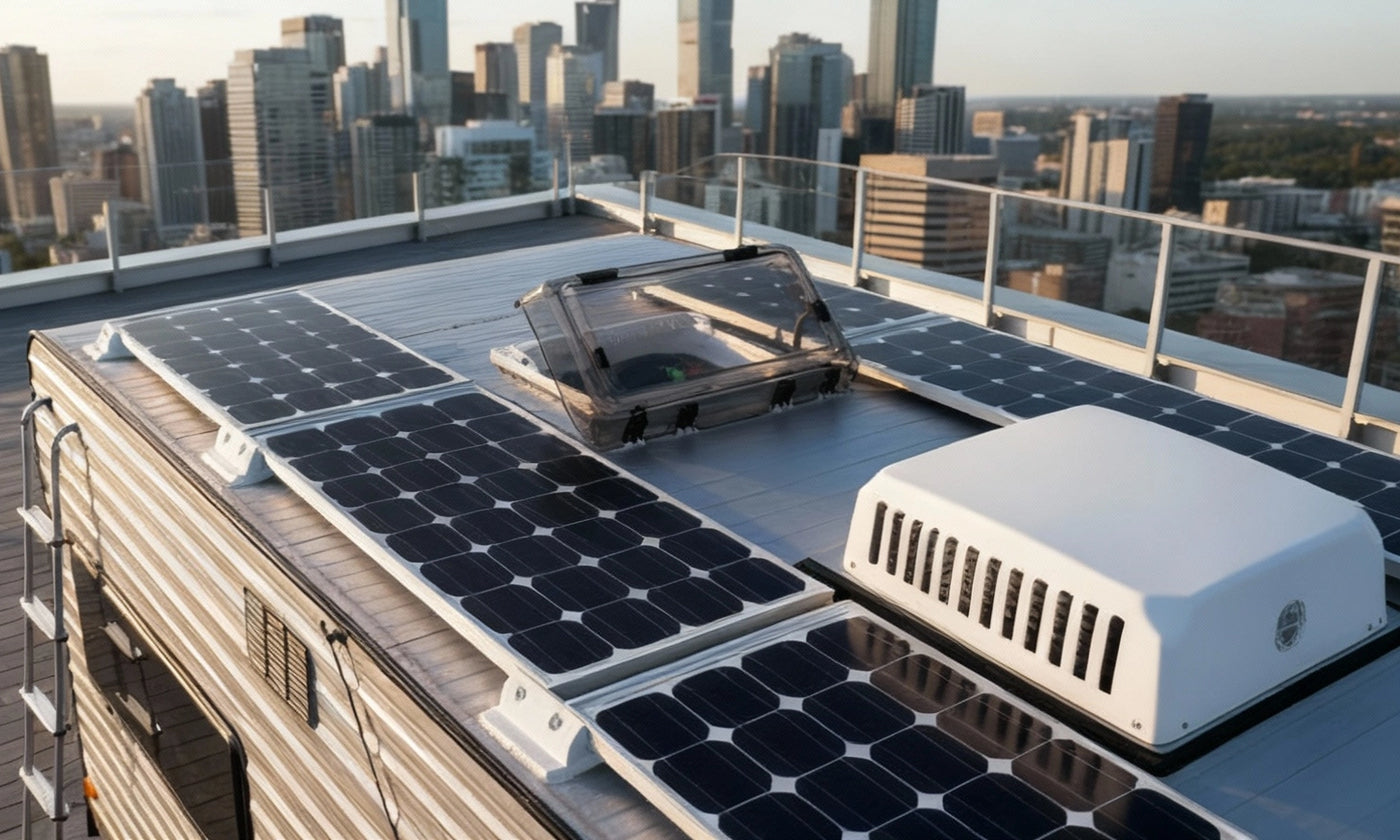
RV roofs are not flat warehouse roofs. They have skylights, vents, antennas, ladders, racks, and often gentle curves. That is where flexible and compact panels shine.
Flexible RV Panels
- follow curved fiberglass or metal roofs
- keep height and weight low for stealth builds
- can be bonded directly to suitable surfaces
Rigid RV Panels
- run slightly cooler with airflow underneath
- are ideal on flat sections or custom racks
- can be tilted seasonally for more energy
Many RVs use a mix of both: rigid frames on open roof areas and flexible panels where space is tighter.
LinkSolar manufactures panels in mini, flexible, and portable formats, so we can match the shape, voltage, and mounting style to your specific vehicle.
Mounting, Wiring & Accessories
A reliable RV solar system is not just about the panels. Good hardware and wiring keep everything safe and serviceable.
We supply and support:
- mounting brackets, tilt mounts, and pole mounts
- MC4 connectors, extension cables, and entry glands
- DC circuit breakers and fuses sized for your array
Shopping for a particular vehicle? See campervan and van life solar panels, caravan and motorhome solar panels, or solar blankets for a fold-out panel at camp.
Whether you are a DIY installer, a professional upfitter, or an RV brand building a new model line, we can help you choose components that work together as a system.
Frequently Asked Questions
How many watts do I need for my RV?
How many watts do I need for my RV?
Most weekenders are comfortable around 100–200 W.
Full-time travelers with a 12 V fridge usually choose 200–400 W.
Power-hungry rigs with inverters, tools, or workstations may need 400 W or more.
A good starting point is to estimate your daily Wh consumption and divide by local sun hours.
Flexible vs. rigid panels for RV roofs?
Flexible vs. rigid panels for RV roofs?
Flexible panels save weight and sit low on curved roofs or stealth vans.
Rigid panels run cooler with airflow underneath and can last longer in harsh conditions.
Many RVs use a mixed array: flexible around obstacles, rigid where a rack fits.
Do I need an MPPT controller?
Do I need an MPPT controller?
For total solar under ~200 W and a tight budget, a PWM controller can be enough.
Above that, or whenever you have higher panel voltage or partial shade, MPPT typically yields 10–30% more energy and is our usual recommendation.
Will solar charge my batteries while driving?
Will solar charge my batteries while driving?
Yes. Solar charges whenever there is light, whether you are parked or driving.
To combine solar with alternator charging, use a dedicated DC-DC charger rather than connecting the alternator directly to the solar controller.
Can you support both DIY users and customized projects?
Can you support both DIY users and customized projects?
Yes. We sell sample panels and small kits for DIY builds, and we also work with RV manufacturers, van builders, and fleet operators on custom, repeatable solutions.
Is roof adhesive safe for TPO/EPDM?
Is roof adhesive safe for TPO/EPDM?
Use compatible primers/adhesives and follow instructions. Clean thoroughly and apply even pressure; periodic inspection is recommended.