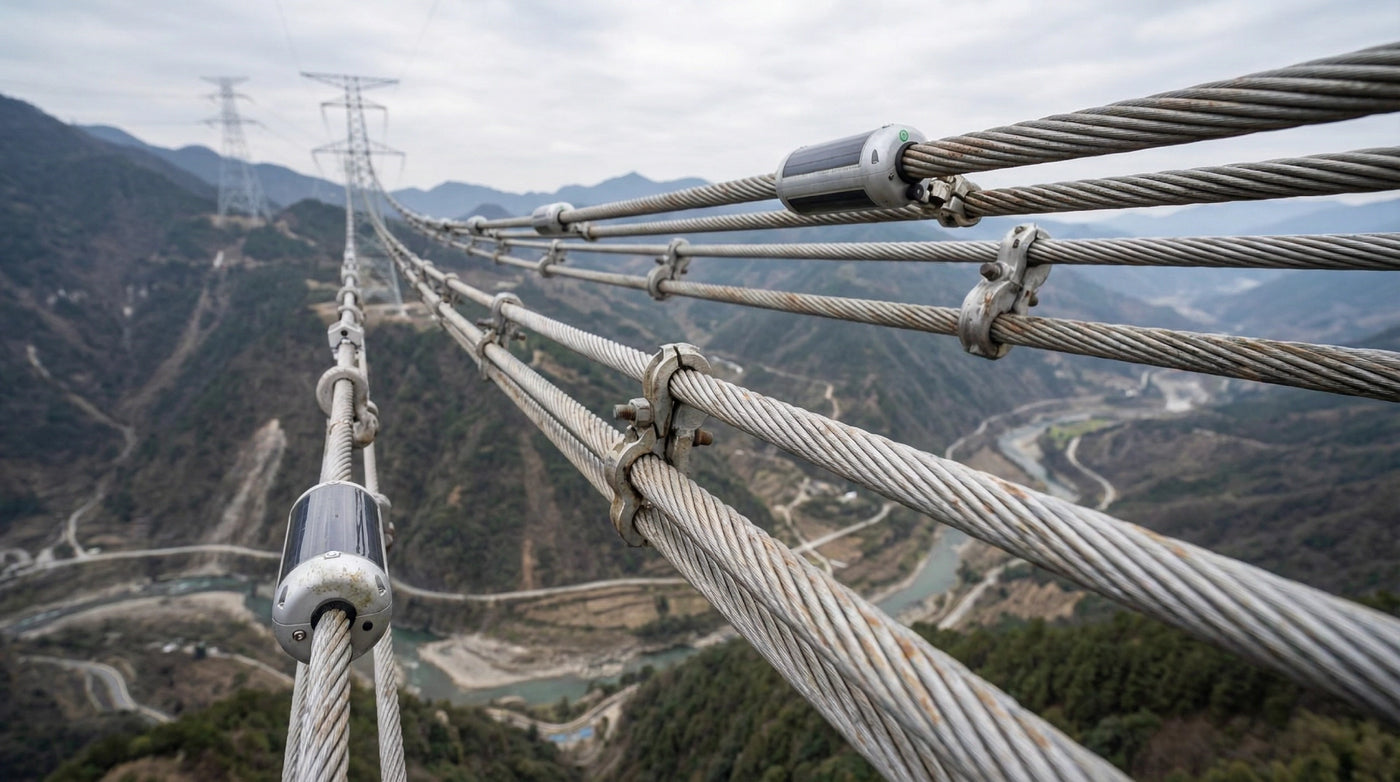

Why Power Is The Weak Link In Grid Monitoring
Smart utilities invest in sensors and analytics, but in remote spans the first failure is often power. Battery-only setups create recurring tower climbs. Adding an auxiliary LV line is slow and expensive. When storms hit, the device that should send a real-time alert is often the first one to go offline.
This is why modern utility monitoring and grid monitoring solution designs increasingly treat power as a core part of the system architecture—not an afterthought.
What a Power Line Monitoring System Typically Includes
When customers search power line monitoring system, they usually mean a full stack:
Edge devices on the line
Overhead sensors for fault detection, waveform capture, load monitoring, and sometimes conductor temperature monitoring.
Communications & backhaul
Cellular/mesh/LPWAN links from line devices to a head-end or cloud platform.
Visual display platform & analytics
A platform that turns events into actionable alarms and workflows (fault location, risk alerting, maintenance planning).
Where LinkSolar fits: we provide the power supply layer that keeps these edge devices alive on overhead lines—so your overhead line monitoring and distribution network monitoring data remains continuous.
LinkSolar Overhead Line Power Supply System
LinkSolar’s system mounts directly on the conductor and combines:
- Line current pickup (energy harvesting) from the conductor via a built-in current transformer
- Curved solar module for additional energy in low-current or low-load periods
- Internal Li-ion battery + regulated DC output to supply stable low-voltage power day and night
Energy harvesting for autonomous overhead-line devices is a proven direction in industry and research, precisely because it reduces dependence on battery swaps and missing infrastructure.
Recommended Devices (35kV+)
| Product/Modle | Typical Use In System | Power Method | Battery | Communications | Key Monitoring / Functions | Size / Weight |
|---|---|---|---|---|---|---|
JK Overhead Line Power Platform (LS-7V4JK series) | Self-powered platform to keep line devices online (fault diagnosis / icing / galloping nodes, gateways, etc.) | CT energy harvesting + solar (dual-input); optional power pickup board | Config-dependent | Supports 4G, GPS/BeiDou, 2.4G | Regulated DC output for downstream payload; clamp-on mounting for conductor Ø23–40mm | 335mm length; <5kg |
WD Galloping Monitoring Device (LS-3V7WD11010) | Conductor galloping monitoring + related condition signals (for transmission line monitoring) | Solar powered (built-in rechargeable battery) | 3.7V 6Ah (up to ~30 days standby @ 5-min reporting without charging) | LoRa-based low-power wireless; max TX 22dBm, up to 500m open area; can bridge to RS485 via receiver module | Galloping amplitude & frequency, conductor temperature, ambient temp/humidity; configurable thresholds & alerts | Ø98mm × 200mm; ≤2kg |
GB Icing Monitoring “Ice Sprite” (LS-9V6GB11110) | Icing monitoring system + video surveillance for line corridor; remote alarm to platform | AC induction (line energy) + solar + high-temp lithium battery | 9.6V 14Ah | Built-in 4G module; supports wireless backhaul (4G/5G/WiFi) | AI-based icing thickness analysis (visual), real-time image/video upload; measures conductor temp & current; lens anti-freeze heating | Compact cylindrical housing; storage ≥128G |
* The JK power supply platform offers various configuration options (such as: solar only, solar + CT, solar + CT + power distribution board, solar + power distribution board + battery, etc.)
Use Cases Supported
Overhead line monitoring on distribution feeders
Power for fault passage indicators, compact fault recorders, and feeder sensors—so operators can restore service faster and reduce patrol time across the distribution network monitoring footprint.
Transmission line monitoring in severe weather
Support icing monitoring devices and conductor temperature monitoring nodes used for condition awareness and risk alerts. Many icing sensing setups are explicitly designed around solar/battery supply at tower locations, which matches real-world constraints.
Line corridor video surveillance & wildfire watch
Stable DC power for compact cameras and edge devices where trenching power is unrealistic—keeping the visual stream and alarms online when weather risk is highest.


Installation & Field Operation
Clamp-on aluminum housing
Lightweight die-cast aluminum body with hinged top/bottom and integrated clamp band. Designed for conductors 23–40 mm in diameter, with grip strength exceeding 50 N in the transverse direction.
Elliptical profile with integrated solar cover
The streamlined oval shape increases solar capture on the curved PV surface compared with flat enclosures. The PV is protected by a high-transmittance, high-strength, anti-yellowing glass shield.
Harsh-environment design
Fully sealed to IP66 with an operating temperature from –40 to +85 °C and humidity up to 100 % RH. Suitable for alpine, coastal, desert and tropical environments, up to 5500 m altitude.

Electrical Characteristics
Line voltage: 35 kV and above overhead transmission lines
CT input: designed for primary currents around 5–20 A; typical available power ≥1.5 W into downstream circuits
PV input: approx. 6 W nominal with ~22 % module efficiency
Battery: 7.4 V / 10 Ah Li-ion pack for multi-day autonomy
DC output: adjustable around 8.4 V to match your device input, with over-voltage and current-limit protection
Key benefits for utilities and system integrators

Customized and system integration with LinkSolar
LinkSolar can supply the overhead line power platform as a stand-alone product or as part of a complete monitoring solution.
- Output voltage, connectors and cable harnesses can be customized to your sensor and communication hardware.
- We design matching small solar modules and brackets when tower-mounted devices also need auxiliary power.
- Our engineering team supports power budgeting, site layout and pilot project planning for transmission utilities and solution providers.
Frequently Asked Questions
Is this just a power supply, or a complete overhead line monitoring system node?
Is this just a power supply, or a complete overhead line monitoring system node?
It’s a self-powered monitoring system node for overhead line monitoring—not only a power module. The unit integrates energy harvesting from the conductor (CT), a curved solar panel, internal battery management, and regulated DC outputs to support monitoring payloads. Depending on your project, we can deliver it as:
- Power + enclosure platform for your chosen sensor/communication module, or
- A more integrated front-end node aligned with your distribution network monitoring architecture (power + wiring harness + mounting + interface requirements).
How does it keep monitoring online during low-load periods and long nights?
How does it keep monitoring online during low-load periods and long nights?
The system uses a hybrid energy strategy: conductor energy harvesting + solar assistance + internal battery. When line current drops or sunlight is limited, the battery bridges the gap so your monitoring payload stays online. For utility monitoring deployments, we size the configuration based on your payload’s average/peak consumption and required autonomy hours, so the node remains reliable across seasonal and load variations.
How do we choose the right output voltage and connectors for our monitoring equipment?
How do we choose the right output voltage and connectors for our monitoring equipment?
Most monitoring stacks use regulated DC power, but the exact voltage and connector types vary by device vendor. LinkSolar supports custom output voltages and cable harnesses to match your monitoring hardware, including connector selection, polarity protection, and strain relief for outdoor installs. If you provide your device spec sheet (voltage range, peak current, connector type), we can propose a ready-to-integrate configuration.
Is installation complicated? Do we need to run extra cables or add a separate power cabinet?
Is installation complicated? Do we need to run extra cables or add a separate power cabinet?
No additional low-voltage feeder is required. The unit is built for overhead deployment and clamps/mounts near the monitoring device location. This reduces trenching, pole-side cabinets, and ongoing battery-replacement climbs. Your crew typically only needs standard line-access procedures, and we provide mounting guidance and basic wiring diagrams for the monitoring device integration.
How do we validate reliability before full rollout (pilot support)?
How do we validate reliability before full rollout (pilot support)?
We recommend a small pilot on representative feeders/spans. We help you define: site selection, expected load/current ranges, sunlight conditions, device power budget, and alarm/uptime targets. During the pilot, you can verify continuous remote monitoring behavior, battery performance during worst-case periods, and stability of real-time alert reporting. Once validated, we standardize the configuration for scaled deployment.
