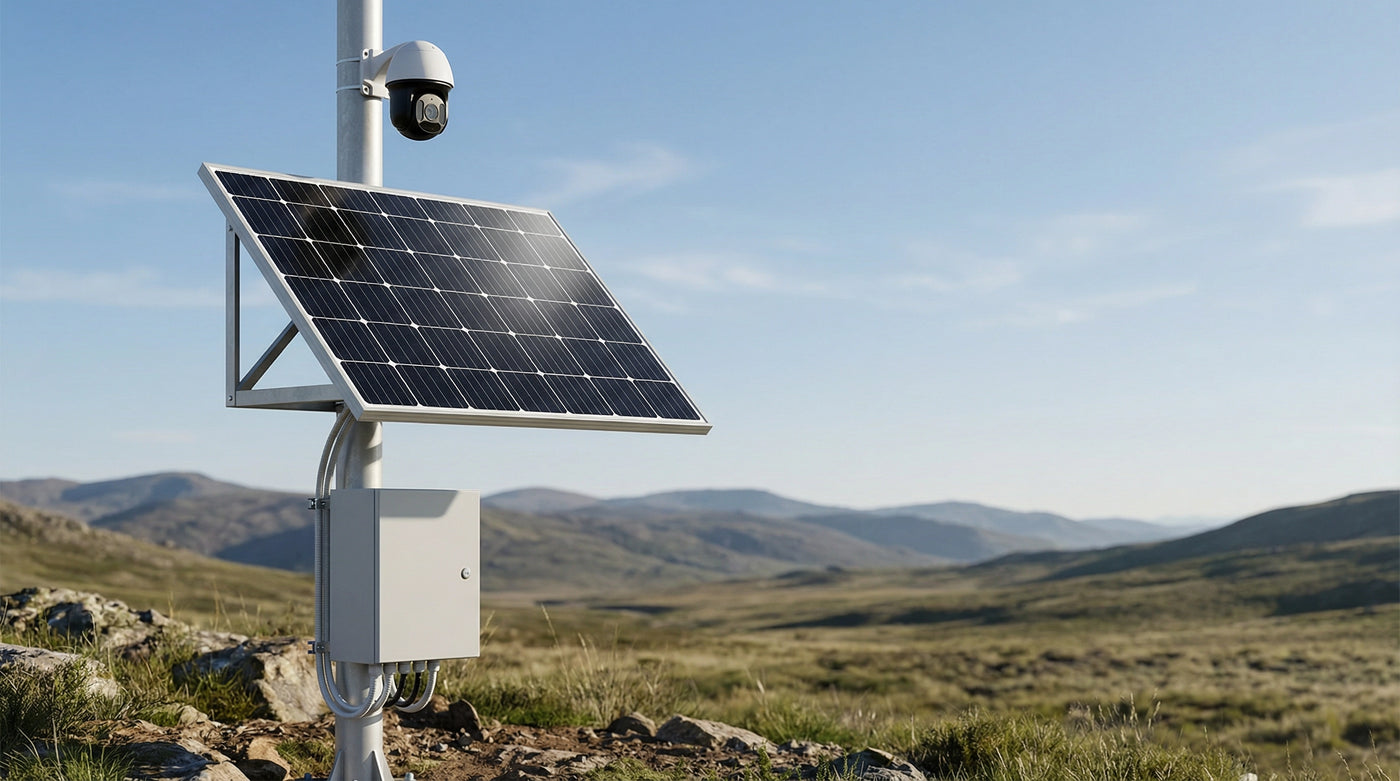

Stop Truck Rolls. Start Reliable Uptime.
Remote sites fail for predictable reasons: undersized panels, poor mounting angles, and batteries that degrade too fast. A proper Remote Solar Power System is a packaged approach—generation, storage, control, mounting, and safe wiring—so your device stays online through storms, short winter days, and long unattended intervals.
Applications for Remote Power Systems
- Security cameras, gates, and perimeter monitoring
- Environmental monitoring, weather stations, and data loggers
- Farms, rivers, ridge-top masts, construction sites, and off-grid infrastructure
- Teams that want fewer service visits through smarter sizing and field-serviceable wiring
What’s Included in a Off-Grid Solar System
A complete power path: Panel → Controller → Battery → Load
A remote solar power system is only as reliable as the full chain.
We package the PV module(s), charge controller, battery storage, mounting hardware, and weather-ready wiring so your load sees stable power
—especially during cold mornings, cloudy stretches, and high-draw events (radios, IR LEDs, modems, or actuators).
Choose Your Remote Solar Power System Class
-
![Solar_Power_System_LS-140W60A]()
Compact Class (Lower Loads / Tight Budgets)
Best for low-to-mid draw devices or duty-cycled nodes. Expect simple deployment, manageable battery size, and fast field installation when the site has decent sun access.
For example: Model LS-100W50A
-
![Remote Solar Power System LS-240W100A]()
Balanced Class (Higher Duty Cycles / More Autonomy)
Designed for heavier daily energy use—routers, gateways, longer transmit windows, or multi-device setups—where you want stronger recovery after cloudy days and less performance anxiety in winter.
For example: Model LS-300W180A
-
![Solar_Power_System_LS-600W300A]()
Extended Uptime Class (Winter-Ready / Higher Reserve)
For critical sites that must stay online through storms, short days, or limited service access. Built with more reserve so the system can ride through multi-day low-harvest periods.
For example: Model LS-600W300A


Typical Remote Solar Power System Configurations
Below are specification examples to help you anchor size ranges. Actual sizing depends on your load profile (Wh/day), worst-month sun, and required autonomy days.
If you share device datasheets and duty cycle, we’ll recommend the most cost-effective configuration.
| Model | Peak Power | Panel Dimensions | Battery Capacity | Battery Weight | Charge Current | Bracket Weight |
|---|---|---|---|---|---|---|
LS-600W400A | 150W×4 | 1320×670×35mm×4 | 400A | 17kg | 60A | 7kg |
LS-300W180A | 150W×2 | 1320×670×35mm×2 | 180A | 8.5kg | 30A | 9.5kg |
LS-240W130A | 120W×2 | 1000×670×25mm×2 | 130A | 6.7kg | 10A | 9.5kg |
LS-240W100A | 120W×2 | 1000×670×25mm×2 | 100A | 4.6kg | 10A | 9.5kg |
LS-200W100A | 100W×2 | 800×670×25mm×2 | 100A | 5kg | 10A | 7kg |
LS-200W80A | 100W×2 | 800×670×25mm×2 | 80A | 4.5kg | 10A | 7kg |
LS-180W100A | 180W | 1480×670×30mm | 100A | 6.2kg | 10A | 7kg |
LS-150W100A | 150W | 1320×670×35mm | 100A | 6.2kg | 10A | 7kg |
LS-150W80A | 150W | 1320×670×30mm | 80A | 4.5kg | 10A | 7kg |
LS-140W70A | 140W | 1200×670×30mm | 70A | 3.9kg | 10A | 7kg |
LS-140W60A | 140W | 1200×670×30mm | 60A | 3.9kg | 10A | 7kg |
LS-120W70A | 120W | 1000×670×30mm | 70A | 3.9kg | 10A | 7kg |
LS-120W60A | 120W | 1000×670×25mm | 60A | 3.6kg | 10A | 7kg |
LS-120W40A | 120W | 1000×670×25mm | 40A | 2.9kg | 10A | 7kg |
LS-100W50A | 100W | 800×670×25mm | 50A | 3.6kg | 10A | 7kg |
LS-100W40A | 100W | 800×670×25mm | 40A | 2.9kg | 10A | 7kg |
LS-80W30A | 80W | 530×670×25mm | 30A | 1.45kg | 5A | 3.5kg |
LS-60W45A | 60W | 530×670×25mm | 45A | 3.3kg | 5A | 3.5kg |
LS-60W40A | 60W | 530×670×25mm | 40A | 2.9kg | 5A | 3.5kg |
LS-60W40A-P | 60W | 350×600×25mm | 40A | 1.45kg | 5A | 2kg |
LS-60W30A | 60W | 530×670×25mm | 30A | 1.45kg | 5A | 3.5kg |
LS-45W27A-P | 45W | 530×670×25mm | 40A | 2.9kg | 5A | 2kg |

Core Features for Unattended Outdoor Deployments
- High-efficiency, low-power controller with 0V start for reliable charging and less manual maintenance.
- Built-in safety protections: overcharge/over-discharge protection plus trickle charging to help extend battery life.
- Triangle mounting bracket for quick installation and optimized tilt; baked paint finish for tough outdoor conditions.
- Monocrystalline solar panels with ≥21% efficiency and aluminum frame for long outdoor service life.
- Ternary lithium battery designed for frequent cycling (listed as 1500+ charge/discharge in the feature notes).
- Aviation-grade waterproof 4-core switch cable to reduce short-circuit risk and improve connection safety.

Sizing That Survives Winter
- Add up each device’s average watts × daily hours. Include standby draw—remote equipment “idles” more than people expect.
- Use worst-month sun hours, then add margin for wiring, controller losses, temperature, and conversion overhead.
- If uptime matters through long cloudy spells, add battery reserve first; it’s often the cleanest way to reduce service visits and avoid brownouts.

Placement Beats Oversizing
- Most failures come from moving shade lines and shallow tilt that collapses winter harvest. Fixing placement often beats buying more panel.
- Keep DC runs short, label connections, and avoid messy cable paths that invite water ingress or voltage drop.
- Place enclosures where techs can safely access them, keep wiring tidy, and make swap-outs quick—without dismantling the site.
FAQ
Remote Solar Power System
How do I choose the right system size?
How do I choose the right system size?
Share Wh/day + worst-month sunlight + required autonomy days. We size panel and battery together so uptime survives winter.
Do I need MPPT or PWM?
Do I need MPPT or PWM?
MPPT helps in winter/partial shade and higher-voltage arrays; a quality PWM can work for simpler 12V systems.
Will it run through long cloudy spells?
Will it run through long cloudy spells?
That depends on your autonomy design (battery capacity + duty cycle). If uptime is critical, design for more days of reserve first.
Does a higher-efficiency panel help on cloudy days?
Does a higher-efficiency panel help on cloudy days?
No. Efficiency decides how big the panel is for its rating, not how much it makes under cloud. On an overcast day a panel still gives a fraction of its rating. Past customers' field reports put it at around a fifth, and close to nothing when it is very dark. An MPPT controller does not change that. For a site that has to stay up through cloudy weeks, add panel watts and battery reserve for the worst month.
Is it suitable for harsh outdoor environments?
Is it suitable for harsh outdoor environments?
Yes—these systems emphasize outdoor mounting, weather resistance, and safer wiring practices for remote deployments.
Does the charge controller need an IP67 rating?
Does the charge controller need an IP67 rating?
It needs protection, but the rating does not have to be on the controller itself. Either buy a controller that carries the rating, or put a standard controller inside an IP67 enclosure with cable glands, out of direct sun. Do not save money on the controller. It protects the battery, and a good one is what saves you a site visit.
Can you customize connectors and mounting?
Can you customize connectors and mounting?
Yes. We can match connectors/cables and mounting methods to your device enclosure and installation constraints.