We supply solar panels for security cameras, battery power boxes, mounts and outdoor network parts for DC cameras, 4G cameras, trail cameras and CCTV points without mains power. This collection covers the power and mounting side; we do not supply security cameras, except for the bird-feeder camera with its own 4 W panel.
How to size solar power for a security camera
Start with measured average consumption, including standby, recording, night illumination and cellular transmission. Panel wattage and maximum DC output are different limits.
-
Calculate daily energy: camera average watts × 24 h = Wh/day. One watt-hour means one watt used for one hour, as defined by the U.S. Energy Information Administration.
-
Use worst-month peak sun hours: daily solar energy in kWh/m² equals peak sun hours at a reference irradiance of 1 kW/m² (NLR performance parameters). Use the resource at your installation, including seasonal shade.
-
Estimate panel watts: daily Wh ÷ peak sun hours ÷ 0.86. The divisor allows for the 14% default system losses in the NLR PVWatts manual. This is a starting estimate; battery charging, conversion and site conditions can require more capacity.
-
Size storage: daily Wh × days without sun = required usable battery Wh. Nominal 18650 pack Wh = cells × mAh × 3.7 V ÷ 1000; usable energy is lower.
Worked example: an event-triggered 4G camera averaging 1 W needs 1 × 24 = 24 Wh/day. At 3 peak sun hours, 24 ÷ 3 ÷ 0.86 ≈ 9.3 W: choose the 12 W box rather than the 4 W as the starting panel size. Three days require 24 × 3 = 72 Wh usable. Six 3,300 mAh cells hold 6 × 3,300 × 3.7 ÷ 1000 ≈ 73 Wh nominal, matching the 25 W page, but that page estimates only about 55 Wh usable. A full six-cell pack therefore falls short of three days at 1 W.
A continuous 4 W camera consumes 96 Wh/day and needs about 37.2 W of panel at the same sun resource, exceeding every power box here. See the camera solar power design page for system planning, and the small solar panel for camera guide for more load examples.
Solar panels and camera power parts in this collection
-
4 W solar power box: 5/6/9/12 V DC output, up to six parallel 18650 cells, IP66, included mounting bracket. Batteries not included.
-
8 W solar power box: 5/6/9/12 V DC output, six 18650 slots, IP66; no MPPT. Batteries not included.
-
12 W solar power box: 5/6/9/12 V DC output, up to six parallel 18650 cells, IP66 housing and included bracket. Batteries not included.
-
25 W MPPT solar power box: built-in MPPT, six 18650 slots, 5/6/9/12 V DC output and IP66 housing. Batteries not included.
-
8 W panel with battery holder: 200 × 200 mm panel, four 18650 slots, built-in charge controller, 3.7–4.2 V or 5 V output variants. Batteries not included.
-
25 W solar 4G router kit: separate panel, Wi-Fi 6, six 18650 cells totaling 18000mAh, WAN/LAN port and IP66 housing.
-
Wooden bird-feeder camera: 1080p camera, 2.4 GHz Wi-Fi, 4 W panel and rechargeable 2000mAh battery. MicroSD card not included.
-
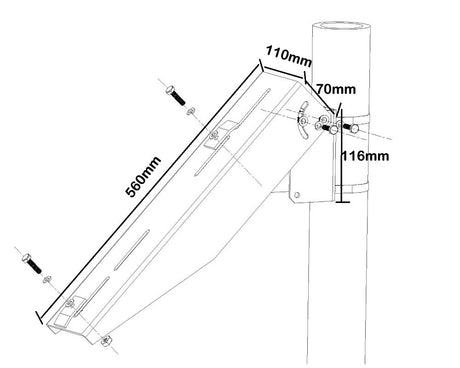
Small wall/pole bracket: for 5–10 W panels, fixed 40° tilt, aluminum alloy and stainless steel hardware.
-
Universal pole mount kit: 5–50 W panels, 50.8–114.3 mm poles, 172–540 mm mounting dimension and 0–90° tilt. Pole and panel not included.
-
Adjustable pole bracket: 3 mm aluminum alloy, for 30–60 W panels and 2-inch poles. Pole and panel not included.
-
Outdoor PoE extender: one PoE input/output, 100M/1G/2.5G/10G choices and IP67 enclosure; power mode depends on model.
-
Outdoor PoE surge protector: 2.5G or 10G options, 48 V nominal, 57 V maximum continuous voltage and grounding connection.
-
Outdoor AC/DC PoE injector: 30 W or 60 W options, 10/100/1000 Mbps and IP67 enclosure.
Check connections before powering your camera
-
Voltage and current: match the camera input and peak demand to the selected output, including night operation.
-
Plug and polarity: the four multi-voltage boxes use a 5.5 × 2.1 mm DC barrel output. Confirm polarity and any adapter; physical fit alone does not establish compatibility.
-
Batteries and weather: use compatible, matched cells, close enclosure seals and keep connections dry.
-
Mount fit: measure pole diameter and panel mounting dimensions, then position the panel clear of shade.
PoE for wired camera installations
For wired PoE cameras, Ethernet carries power and data: the injector adds power, the extender continues a compatible link, and the grounded surge protector adds protection. The injector accepts 100–240 V AC or 44–57 V DC, so it requires a power source at the head end. It is not a solar supply by itself; the 5–12 V boxes cannot directly provide its required DC input.
Guides by installation type
Camera power or something else?
For component builds, browse mini solar panels; for installation hardware, see solar panel pole mounts. Separate battery applications are covered in solar battery chargers. Remote monitoring points have their own pages: forest fire cameras and IoT sensors.
Frequently asked questions
How much solar power does a security camera need?
A camera averaging 1 W needs 24 Wh/day and about 9.3 W of panel at 3 peak sun hours with the stated loss allowance. A 12 W panel is the starting choice; verify usable storage and site conditions.
What size solar panel do I need for a 4G security camera?
About 12 W is the starting size for the 1 W average example. The 25 W product page estimates 11–18 hours without sun for continuous 3–5 W cameras, versus 1.5–4.5 days for event-triggered cameras averaging 0.5–1.5 W. These are product-page estimates, not runtime guarantees.
Can a small solar panel run a security camera at night or through cloudy days?
Yes, with sufficient charged battery storage; the battery supplies nighttime power. At 1 W average, three sunless days require 72 Wh usable, exceeding the 25 W box’s estimated 55 Wh usable pack.
Will this work with my camera brand?
Compatibility depends on voltage, required current, plug dimensions and polarity. Check the 5.5 × 2.1 mm barrel connection and any required adapter before ordering; no brand-wide fit is promised.
Do solar security cameras need Wi-Fi?
No; connectivity depends on the camera. A cellular camera uses mobile service, while a Wi-Fi camera can connect through the solar 4G router kit where cellular coverage and a suitable SIM plan are available. Read the no-Wi-Fi farm gate guide.
What size solar panel do I need for a trail camera?
About 12 W is the starting size if it averages 1 W with 3 peak sun hours; actual consumption and woodland shade determine the requirement. Follow the trail camera panel and battery sizing guide.
Can you build a custom solar power kit for a camera project?
Yes, we can scope custom builds around voltage, battery capacity, mounting and branding requirements. Share the camera load and installation conditions through custom mini solar panels.